The Gentle Flame
“Come to Me, all you who labor and are heavy laden, and I will give you rest. Take My yoke upon you and learn from Me, for I am [a]gentle and lowly in heart, and you will find rest for your souls. For My yoke is easy and My burden is light.” Matt. 11: 28-30
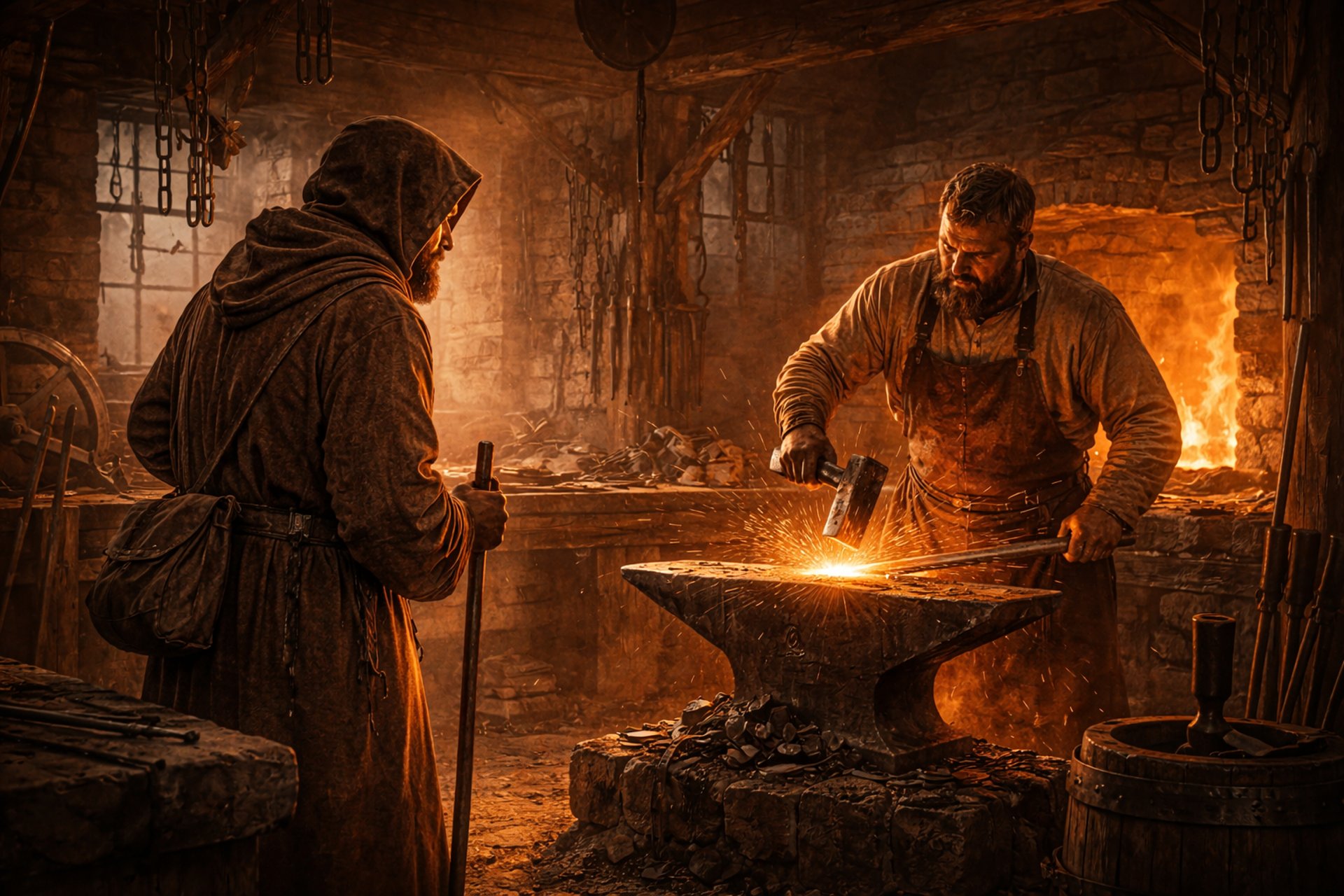
The pilgrim had been traveling since early light, following a road that wound lazily between low fields and sparse trees, until at last it brought him to a village small enough to be missed if one was not paying attention.
The pilgrim slowed his pace, here he thought would be a place to rest for a day or two. His old bones cried for a pause in the journey, his gear also holding on by sheer luck stressed the importance of pausing.
The ring upon his lantern had broken again sometime before noon, and so the little thing hung awkwardly in his hand, more burden than help. It was not the first time. A pilgrim is no stranger to broken tools, especially with his lantern. He had mended it before with twine, and even once with twigs woven together, whichever mercy the Lord had placed near him he was not shy to use. But now he had counted himself blessed. The Lord had allowed him to journey near a town filled life, and inside a man who could fix this for him he imagined.
Yet he had little money. Pilgrims aren’t known for their heavy or deep pockets. He shrugged and with a smile and small prayer to God, he set off into town.
The town was small, that much was given, yet kids ran through the wooden houses, vendors yelled selling goods from spices to meats. Stopping near the fountain he came upon a townswoman near the square, he greeted her kindly with a bow and asked if there might be someone in the village able to mend iron without asking too much silver from a poor traveler.
“You’ll want Eamon,” she said, pointing him down the road toward a dark-roofed forge near a great ash tree. “If it’s broken, he’ll make it hold again and he won’t ask more than what you can spare. Whether that’s wisdom or folly, I’ve not decided. But he’ll help you.”
The pilgrim thanked her and went on.
Before he reached the archways of the forge, he slowed.
A farmer stood there with a horse, and beside it worked a broad-shouldered man wearing a worn leather apron, whose movements were so practiced they seemed older than thought. He bent, lifted, pressed, fitted, and set with the grace of a man who had spent more years at his trade than away from it. There was nothing theatrical in him. No wasted motion. No needless noise. Only repetitive movements worn deep into the body.
When the horseshoe was set and the horse calmed, the farmer reached not for coin but for a small handful of vegetables carried in the cuff of his shirt. His hand brought forth corn, a few carrots, and two squat onions still dusted with dry earth from its plucking in the morning.
Eamon smiled warmly as he took them, and though the smile was genuine, the pilgrim saw what followed after the farmer had walked away: a soft sigh, not of annoyance, but of simple knowing. This would not cover cost of goods lost yet the man accepted it anyway.
When the farmer departed, Eamon sat for a moment and lowered his hands into a nearby bucket of water. The soot bled from his skin in black streams until the water darkened like spilled ink. Exhaustion clung to him. Yet even seated, he did not truly rest. His eyes remained on the road, the square, the passing movement of people, as if any sound might at any moment turn into a beckoning of help.
The pilgrim could see that nothing in him had yet come down from his watch.
After a while Eamon took the ear of corn from the farmer’s payment and held it near the forge fire to roast. It was evident the man asked for nothing more than given, but here the man could not hide the pangs of hunger within him. He watched the smith, the giveaway was the slight press of his lips, the brief attention in his eyes, the care with which he turned the corn over the heat.
Then a woman’s old horse voice called from the road.
“Eamon! A hand, if you will!”
Her cart had caught in the uneven dirt road, burdened by the weight of her spiced goods. Eamon glanced once at the corn, then once at the woman, and without a second’s counsel from himself hurried to the woman’s aid. The pilgrim watched the corn darken in the flame as Eamon leaned his shoulder into the cart and helped drive it free.
Kindness has a way to turn a worn face into a beautiful masterpiece, her warmth radiated at him when it was done and, with the casual affection she patted him on the head as she passed.
“Bless you, dear boy,” she said, and went on.
Eamon returned to the fire and found the corn burnt black.
For one brief instant frustration crossed his face, not dramatic, no more than one would call justified, just human. Then he looked upward, uttered something low and quick the pilgrim could scarcely catch it, then with a gentle toss the ruined corn fell before the crows.
It seemed to the pilgrim then that the man did not know how to keep even a ruined thing for himself.
At last, he stepped forward.
“Peace to you,” he said bowing his head.
Eamon looked up, and the warmth he had shown the others remained in him still, the quiet anger of his loss vanished.
“And to you,” said the smith.
The pilgrim’s eyes fell toward the charred corn near the stones.
“I should have taken it from the fire,” he said. “I saw it begin to darken, but I did not wish to intrude where I had not yet been welcomed.”
The pilgrim gave a warm smile before reaching into his satchel and drawing out a small barley loaf, road worn and already partly cut. Ripping it cleanly in two, he held one half out.
Eamon shook his head.
“No, keep it. A traveler would be wise not divide his last bread with a man with has his own forge.”
But the pilgrim pressed it gently into his hand.
“Whether I eat or do not, I have the Lord.”
For the first time, something softer moved through Eamon’s face, something beyond gratitude, more akin to recognition. He smiled.
“So,” he said, “you are a believer yourself then?”
The pilgrim leaned against the support beams of the smithy and glanced toward the village.
“Are many here?”
Eamon let out a small breath through his nose, somewhere between fatigue and humor.
“Not as you and I would believe. Some remember God when fever comes, or when the brutal winter months cause the harvest to fail. There are others who bow their heads when death passes near. But most live as though the world carries on with or without His blessing.
The pilgrim pondered that. He had already begun to see that Eamon spoke of the Lord with reverence and yet carried himself like a man who still expected no hand but his own to keep the day from collapse.
“And what is it you do?” Eamon asked after a while of studying the pilgrim.
The pilgrim smiled faintly.
“I do no great thing,” he said. “I walk, and I observe what the Lord sets before my eyes. Yesterday I may have fished at the riverbank. Tomorrow I may bend in a field among the wheat. And today, it seems, I am brought to iron and fire.”
Eamon laughed then, though not in mockery of the man. There was warmth in it, as if the pilgrim’s word was gentle nudge against his hardened interior. Yet, there was also something worn, as if the sound had risen from a place in him that remembered rest more clearly than it still knew it.
“I cannot remember the last time I stepped into a river,” he said. “Nor when I last let my hands pass through wheat for no reason but to feel it.”
Then he touched the anvil lightly with his fingertips.
“Here is my life,” he said. “The village as small as it may seem, still beats with the passion of a city. If I step away, it begins to feel the loss before the day is out.”
The pilgrim smiled softly.
“A lifeline is always a difficult thing to carry alone,” he said. “A burden few could bear without their knees buckling from beneath them.
Eamon gave a faint shrug, though the weariness in it seemed older than the motion itself.
“A man grows used to it,” he said. Then, after a small pause, his smile bent painfully. “Or else he does not remain where he is needed.”
“Rest, for me, is when the voices from the village begin to quiet. When the tasks fall one by one like the setting sun. When no cart has broken an axle after dark, and no farmer comes pounding at the door because his horse has thrown a shoe before dawn.”
“Then, after a moment, he added more quietly,
“Though even then, a man sleeps with one ear open. Rain may still find a weak board. A hinge may still give in the night. There is always something. Some part of the mind keeps standing, even after the body has agreed to lie down.”
The pilgrim watched him with gentle eyes, and only then did he answer.
“I have gone far enough upon the roads of life,” he said, with a soft chuckle, “to learn that men name many strange things by the word rest. In the north they hurl axes at tree trunks and call it pleasure. In the western isles they stretch themselves upon the shore while the sun roasts them like coals from your furnace and call it peace.”
Then his smile gentled.
“But what you describe sounds to me less like rest than the quieting of labor.” Eamon glanced up at him, not offended, only caught by the thought. For a moment he seemed ready to answer, but instead he let out a small breath through his nose.
“If you know a better kind,” he said, “you are welcome to name it.”
The pilgrim reached into his satchel and drew out an apple.
With his old knees aching the pilgrim motioned towards a small bench, “may I?”
“of course,” Eamon spoke, his arm pulling the bench towards the old pilgrim.
Slowly he sat on the wooden bench, rustling into his bag before finding a ripe red apple he had found on the trail, “I suppose we might divide this as well.”
Eamon smiled at that and accepted.
Then his eyes dropped to the lantern in the pilgrim’s hand.
“I noticed your lantern was broken,” he said. “That ring there, near the top. I can mend that easily enough.”
“Ah yes, this…how much would it cost me” he softly spoke grabbing what little copper he had left.
“Keep your money. A man is not often paid in good company.”
The pilgrim smiled.
“That little ring been a troublesome companion for some time,” my friend. I have bound it back together too many times to count, yet it still serves its purpose even broken. Wouldn’t you agree?” His old eyes met him.
Eamon shook his head with a smile and took the lantern into his hands. His hand turned the small ring beneath the light, thumb brushing the worn ring with a craftsman’s familiarity. His brow lifted.
“Well now,” he said. “This iron is old. Where did you come by such a piece as this?”
The pilgrim smiled, knowing the master smith might catch on to its aged appearance. “When a man journeys long enough, what once seemed new begins to show its years. A little weather each day will wear even fine metal thin.”
Eamon nodded slowly.
“It’s worn, yes, but not ruined. Old iron often keeps more honesty in it than new.”
The pilgrim could not resist the grin forming on his face.
“So, you have been here long, then? I can see you move about this place as though your hands learned its corners before your thoughts did. Did you make this forge yourself?”
Eamon gave a small shake of the head.
“No,” he said. “My father built most of what stands here. I’ve patched the roof, widened it to make room for more tools, and cursed it enough times that some might mistake it for mine, but her bones belong to my father”.
He turned the lantern slowly in his hands, the old iron catching the firelight in dull red glints.
“I was small when I first learned the sound of this place. Hammer against iron. The Bellows deep breathing and the vicious hiss of hot metal in water.”
A faint smile touched his face.
“Some men remember songs from boyhood. I remember the forge.” For a moment his gaze drifted somewhere beyond the walls, though not far for long.
“There was always work,” he said simply. “My father had his trade. My mother had hers. So, I learned young enough not to stand idle.” Then he looked back down at the lantern, and whatever memory had begun to soften in him folded quietly away again.
“Some men are given fields. Some are given roads. I was given this.”
The pilgrim said nothing for a time. One could see a tenderness in Eamon still, that much was plain. But it seemed to the pilgrim that the tenderness had been taught to labor before it had ever been taught to seek rest. Then, after a little pause, the pilgrim drew from his satchel a small, weathered book bound in sun kissed worn leather.
“Tell me, Eamon,” he said, “do you care at all for drawings?” For a moment Eamon only stared at him, as though the question had come from so far outside the ordinary course of his life that he hardly knew where to place it.
“A drawing?” he said at last. “I have not looked upon one in ages.”
Then, to the pilgrim’s quiet delight, a boyish smile came over his face suddenly and unguarded, like something that had not risen from its deep slumber in ages.
“What did you paint?”
The pilgrim smiled.
“Oh, it was not I. It was gifted by a traveler far more seasoned than myself, and far better with a hand than I shall ever be. Carefully he opened the little book and shifted slightly upon the bench.
“Come,” he said, “sit, and I will show you.”
The pilgrim watched the change in him with quiet interest. There had been no such light in Eamon’s face when speaking of task, or his aged tools, or broken things brought to be made whole. But at the mention of a drawing, something younger had stirred beneath the soot-stained face, as though the man had not entirely forgotten wonder just merely laid it aside too long beneath the heavier instruments of duty.
Eamon leaned in as the pilgrim opened the book. There, upon the page, was the drawing of a father seated beside a low hearth, one arm resting around a child asleep against his chest. The fire had burned down to a gentle glow. No labor filled the room. No urgency. No tool was in motion. The man was simply there, and the child rested as though no safer place had ever existed beneath heaven.
Eamon’s eyes moved slowly over the page, tracing the lines of the father, the child, the quiet fire. At last, he frowned slightly.
“What are they doing?” There was almost a harshness in the question, as though he felt with absolute certainty that something must be missing.
“Just sitting?” he said. “I cannot imagine such a thing.”
The pilgrim smiled warmly.
“They are resting.”
Then he touched the page lightly.
“Here is another kind of fire Eamon, the kind that asks nothing to be forged, only someone to be near it.” Eamon’s jaw clenched slightly. He did not answer at once. At length he gave a short breath through his nose.
“The child, perhaps,” he said. “A child may rest. But the father?”
His finger hovered over the page, not quite touching it as if a distant memory taunted his mind.
“If his hands are still, who keeps the roof from sagging? Who mends the wheel when it splits? Who sees to the next day’s wood?” The pilgrim’s smile did not fade.
“Perhaps no one,” he said. Eamon looked at him sharply. The pilgrim only went on, his voice calm as a stream pouring over a stone.
“Or perhaps the roof waits one evening more. Perhaps the wheel will remain broken until morning. Perhaps the wood is gathered at dawn instead of dusk. Not every unanswered need is a ruin, my friend.” That last sentence settled over Eamon with strange weight.
He looked back at the page. The child slept on, untroubled by unfinished things. The father’s face, though only rendered in ink and careful shadow, bore no shame in its stillness.
Eamon frowned.
“It feels wrong.”
“Why?” Eamon was silent a moment longer, and when he spoke again his voice had lowered.
“Because there is always something needing to be done.” The pilgrim said nothing. Eamon went on, not in confession, but in the speech of a man stating what seemed so obvious to him.
“A hinge loosens. A horse throws a shoe. Rain finds a weak board. Someone’s stove gives trouble. Someone’s gate leans endangering the fence. Someone’s plow cracks when the earth is more stubborn than the iron. There is always something. If a man sits while there is still something, what right has he to his ease?”
The pilgrim leaned back slightly, the little book still open between them.
“And if a man never sits,” he asked softly, “what right has he to call himself alive?” That struck Eamon more deeply than rebuke would have done. His eyes lifted from the dusted page and found the pilgrim’s face, but only briefly. Then they fell again, as though the question had reached some secret chamber in him, he did not often open.
The wooden locks cracked within the furnace. Outside, beyond the doorway, came the far sound of merchant’s carts creaking over packed earth and the call of two children chasing one another down the road, the silence of the night surrendering to their laughter. Eamon listened to it without seeming to mean to.
Then he looked again at the drawing.
“He is doing nothing,” he said, though the sternness had gone from it now. The once judgmental thought gave way to an unrecognized emotion to him.
The pilgrim’s expression gentled even further.
“No,” he said. “He is keeping warmth.” The words entered the room and demanded attention. Eamon’s fingers, rough and dark in the creases, closed a little over the edge of the page. The pilgrim saw then that the man was moved, though he would not yet believe it himself.
“There are fires,” the pilgrim continued softly, “that shape iron. And there are fires that keep a house from becoming cold. A wise man knows the use of both.”
At this, Eamon’s mouth bent faintly, though not quite into a smile.
“You speak as though I have neglected half my craft.”
The pilgrim chuckled softly.
“I speak as though a man may become so faithful to one flame that he forgets the other.”
That sentence seemed to find its place in Eamon and remain there. The fingers that caressed the painting withdrew. He closed the little book carefully, slower than he had taken it up, and handed it back to the pilgrim with reverent care. Eamon leaned back and closed his eyes, and for a moment he did not move. Then abruptly, as if ashamed to be found standing so long in thought, stood up and grabbed the lantern and placed it upon the worktable.
“Let me mend this for you,” he said.
But the pilgrim noticed his hands did not carry the same command as they did earlier. Eamon took up the ring and held it near the fire, watching the old iron warm. His eyes stayed on the metal, yet it was plain he was thinking of something else. The pilgrim let silence sit between them. He had learned long ago that some truths enter a man noiselessly, like evening light pouring through cracks of a door. To speak over them too quickly was to frighten them away.
The ring turned from darkened black to a simmering orange as it spun in the fire.
Eamon reached for his tool, then paused.
“When I was young,” he said, still looking at the fire, “my mother used to come in from the fields after dark. Some nights she would say nothing at all. She would only sit by the hearth and hold her hands toward it.”
He lightly shook his head, as though surprised the memory had sprung from deep within the dungeon of his soul, as if breaking free after years of confinement.
The pilgrim kept still.
Eamon’s thumb shifted slightly on the lantern’s frame.
“I never understood it,” he said. “I thought if she had strength enough to sit, she had strength enough to mend something, sweep something, set something in order. But she would only sit there in the hearths light as if the task itself required her every attention.”
The pilgrim smiled, though his voice remained quiet.
“It did”
Eamon said nothing.
The iron held in his tongs hand had grown ready, and he began bending it to take form. Yet the pilgrim could see the work had changed. The smith no longer moved with the hard mechanical movements of a man merely completing a task. There was consideration in him now, almost tenderness, as though the old ring had become more than a broken piece of metal.
He set the softened iron, adjusted the weakened place, and brought it back into shape with small, precise movements. Not many blows. Only enough.
The pilgrim watched the hammer rise and fall, and after several hits, he spoke softly to the worn blacksmith.
“You see? Even now it is not the striking that does the deeper work. The iron yielded when it was warmed.” Eamon lowered the hammer very slowly. The words did not seem to offend him. They had found soft soil within his heart and taken root to quickly for him to respond.
At last he spoke.
“Warmth makes it yield,” he said, almost to himself. “Aye. That is true enough.”
But something in his voice told the pilgrim that this truth had not fully formed in agreement within his soul just yet. He waited. Eamon set the lantern down and reached for the bucket, dipping his fingers into the darkened water as though to cool more than skin. To distract his mind from plunging any further into confronting alien thoughts never welcomed. The blackness stirred around his knuckles in slow clouds. When he spoke again, it became quieter.
“Iron does not disappoint you for softening.”
The pilgrim did not answer at once. Outside, night had begun its slow descent upon the town. The voices from the road were fewer now. Eamon drew his hand from the water and watched the drops fall.
“If metal yields, it may yet be made useful. If a hinge bends, a wheel gives, a plow is set right, then something good comes of it.” He rubbed his thumb against the heel of his palm.
“But men…”. There he stopped. The pilgrim kept still, he watched carefully as the image of rest danced upon the man’s face, the worn leather book resting closed in his lap.
Eamon let out a breath through his nose, and this time there was no laughter hidden in it.
“If a man yields too much,” he said, “the world has a way of taking it for weakness. If he rests too long, things go wanting. If he softens in the wrong place, then others bear the cost for his lack of diligence.”
The pilgrim looked at him with that same quiet attention he had borne from the beginning.
“Is that what you were taught?”
Eamon’s mouth turned faintly, though not from humor, as if he fought with every fiber within him to hold back a small tear.
“No one sat me down to say it plain.”
His gaze moved toward the doorway, where evening had begun to gather beyond the threshold.
“You only live long enough in an environment, a certain kind of season, and the lesson enters your bones before words ever trouble to clothe it.”
The pilgrim lowered his eyes for a moment. A small nod escaped him.
“And yet your own craft teaches otherwise.”
Eamon glanced at him, weary but attentive. The pilgrim nodded toward the lantern.
“You did not mend the iron by punishing it. You did not curse the weakness from the ring. You did not strike it cold until it obeyed.” He leaned forward slightly.
“You brought it near the fire. You gave it what would make it ready to welcome change. Then you laid only enough weight upon it to help it keep its form.”
Eamon’s hand remained resting on the edge of the table.
He said nothing.
The pilgrim’s voice stayed warm.
“Tell me, master of iron, why are you wiser with old metal than with your own soul?” That found him. Not like a blow. More like a key turned quietly in a door long shut. Eamon looked down. For the first time since the pilgrim had entered the forge, the smith appeared not merely tired, but defenseless before his own thoughts. The lines of his face, worn by labor and years of answering every call, seemed now to loosen into something nearer sorrow.
He laughed once, but it was frail and passing.
“You make a hard case against a man in his own shop.”
The pilgrim smiled.
“No. Only a true one, I think.”
Eamon ran a hand across his jaw.
“What would you have me do?” he asked. “Sit by fire while wheels split and roofs cave in? Let men wait while I learn to admire the evening?”
There was no mockery in it now. Only strain. The pilgrim rose from the bench, but not in quickness or boldness. He stood like one stepping nearer a frightened animal offering it compassion or food, careful not to startle it from the hand meant to help.
“I would have you learn the difference,” he said, “between neglect and nourishment.”
Eamon’s watered eyes lifted to him.
“I do not speak against duty, Eamon. I speak against the lie hidden inside it, the lie that tells you a man is holy only when he is emptying himself to others, and worth keeping only so long as he can still be spent.”
The last light of day touched the forge floor in a long dim stripe. Eamon stood motionless within it. The pilgrim’s voice softened further.
“You have mistaken duties constant cry for completion for faithfulness.”
That sentence entered him and stayed. For a time, there was only the low hums of the coals. At length Eamon turned away, not in rage, but in the old instinct of a man who had always found motion easier than confronting feeling. He reached for a pair of tongs, set them down again, scanned the workshop letting his hands blindly straighten a tool that did not need straightening. At last, he stopped. His shoulders had not slumped, yet something in him had yielded. He looked toward the open road beyond the doorway.
The village was quieter now. One by one the sounds had thinned.
“The evenings my mother would sit by the hearth after the fields. I thought it was laziness then. Or weakness perhaps. She would only hold her hands toward the fire and close her eyes as if she were listening to something I could not hear.”
His lip quivered as the memory of a woman worked to her core sitting for a moment of peace by the fire, a smile crept upon his face painfully. He went to the doorway and stood there, one broad hand against the frame, looking out as the village settled into dusk. Smoke rose in faint grey threads. Somewhere nearby someone had started a small evening fire, and its scent drifted softly through the cooling air.
At last Eamon spoke, and his voice was low enough that it almost belonged to the evening more than to him.
“I do not know how.”
The pilgrim came to stand a few paces behind him.
“How to what?”
Eamon did not turn.
“How to be near a fire that asks nothing of me.” There it was. Not the entirety of the wound, perhaps but enough for healing to take place. But the truest portion of this wound had not yet been spoken aloud. The pilgrim looked past him to the first darkening shapes of the road.
“Then perhaps,” he said, “the mercy of God is that a man need not learn it all in one night.”
Eamon gave a small breath, almost a laugh, though grief had gentled it.
The pilgrim went on.
“You need not abandon your duties of the forge to begin. You need not become less faithful. You need not drop the village from your shoulders all at once. But perhaps tonight, before sleep takes you, you might draw near a little while before your own hearth and let the fire be only fire.” Eamon was quiet.
The pilgrim added, with a faint smile in his voice,
“And if your hands begin reaching for a tool, perhaps let them fail you once.”
That drew from Eamon a truer laugh that was small, but real.
He turned then, and though weariness still marked him, the pilgrim saw something else there now: not yet peace, not yet freedom, but the first narrow opening through which such things might one day enter.
Eamon held out the lantern.
“Your ring is set.”
The pilgrim took it and ran his thumb over the mended place. The join was clean, stronger than before.
“A master’s work,” he said. Eamon shook his head.
“No. Only enough.”
The pilgrim looked at him a moment longer and smiled.
“Only enough is often nearer wisdom than more.”
At the threshold he paused and looked back. Eamon had not returned immediately to the anvil. He stood where the pilgrim had left him, halfway between forge and doorway, as if for once the next demand had not yet claimed him.
“Good evening, master of iron,” said the pilgrim bowing.
Eamon’s face softened.
“And to you, traveler.”
The pilgrim stepped out from the warmth of the forge into the cool night air. He lit the lantern and began pushing forward. He had gone only a little way when he turned once more and glanced back. Through the open doorway he could still see the glow of the forge, fierce and red, at one end of the shop. But farther in beyond the doorway another softer light had been kindled smaller, steadier, a soft gold against the shadows. It took the pilgrim a moment to understand what he was seeing.
Eamon had lit the hearth. And there, in the threshold between labor and evening, the blacksmith had drawn a chair near it. He had not yet sat, but he was looking at it as a man looks upon a road he has never taken. The pilgrim watched only a moment, then went on his way to find rest under the willow tree on the crest of the hill.
As the pilgrim drifted to sleep, he had thanked God again for his wonderful travels across the world. His eyes became heavy as he drifted to sleep. Hours had passed and as the sun crept over the horizon, its rays gleaming across his face he awoke. He bowed before God and prayed, then set out one last time to give kind words to the black smith before leaving the land.
He came close to the town, the air was cool and clean, the kind that lingers only in the early hours before carts begin to groan under the weight of commerce and men began again begrudgingly moving to the days task. His lantern swung lightly at his side, the mended ring holding fast.
He approached the smithy and a smile emerged on his face, a deep happiness from within his soul.
The doors were shut. That alone might have given him pause, but there upon the post hung a small wooden sign, written in an uneven hand:
“Gone fishing.’
The pilgrim stopped and smiled.
It was neither a grand nor marvelous thing. Two words only, crookedly jotted down by hands that were meant to pound iron, not draw across wood. Yet to him they held the heavens treasures.
Without haste, he left the road and made his way toward the riverbank. The path bent through reeds and grass until at last the water came into view, broad and silver beneath the morning sun. Birds skimmed low over their surface. The current moved with that quiet speech known only to rivers, never hurrying, never pleading.
And there, not far off, stood Eamon. A pole was in his hand, though it sat in it with less familiarity than hammer or tong. Now and then he tugged at the line with the irritated stiffness of a man discovering that not all things answer to force. Once he frowned at the reel as though it had personally offended him.
The pilgrim did not call out. He remained where he was and watched.
Eamon tried again. The line jerked suddenly in his grasp, and the surprise of it broke over him so fully that he laughed aloud. He pulled quickly, awkwardly, with all the old instinct to master what resisted him.
Nothing came. The hook rose empty, trailing droplets in the sun. But defeat did not mark his face. Instead, the pilgrim saw something far better.
The old cracks of weariness were still there, yet they no longer seemed only worn into him by labor. They had begun to give way to another shape. The tired lines in his face opened into deeper lines of smiling, as though joy had found, at last, a place in him humble enough to remain.
Eamon looked at the empty hook and laughed again, quieter now, almost as if he had surprised himself. Then he sat.
Not because every task had been done. Not because the village had ceased from breaking. Not because he had earned it. He sat because the river was there, and the morning was there, and for once he allowed himself to be there too.
The pole rested across his knees. One hand dipped into the moving water. He watched the surface as though listening to something he had forgotten long ago. The pilgrim bowed his head.
He did not go to him. He did not speak. The moment was too gentle for words.
So he turned back to the road with a quiet heart, leaving the blacksmith to the river, the empty line, and the strange new kindness of an hour that asked nothing of him.
And as he went, the pilgrim thanked God quietly for the morning, and for the kind of rest that comes as grace before it is ever understood.
Sometimes the first sign that a soul is healing is no greater than this:
a crooked board upon a post,
and the humble witness of two uneven words,
“Gone fishing.”