The Kind Stranger
Not all gentle men are what they appear to be
27 min read
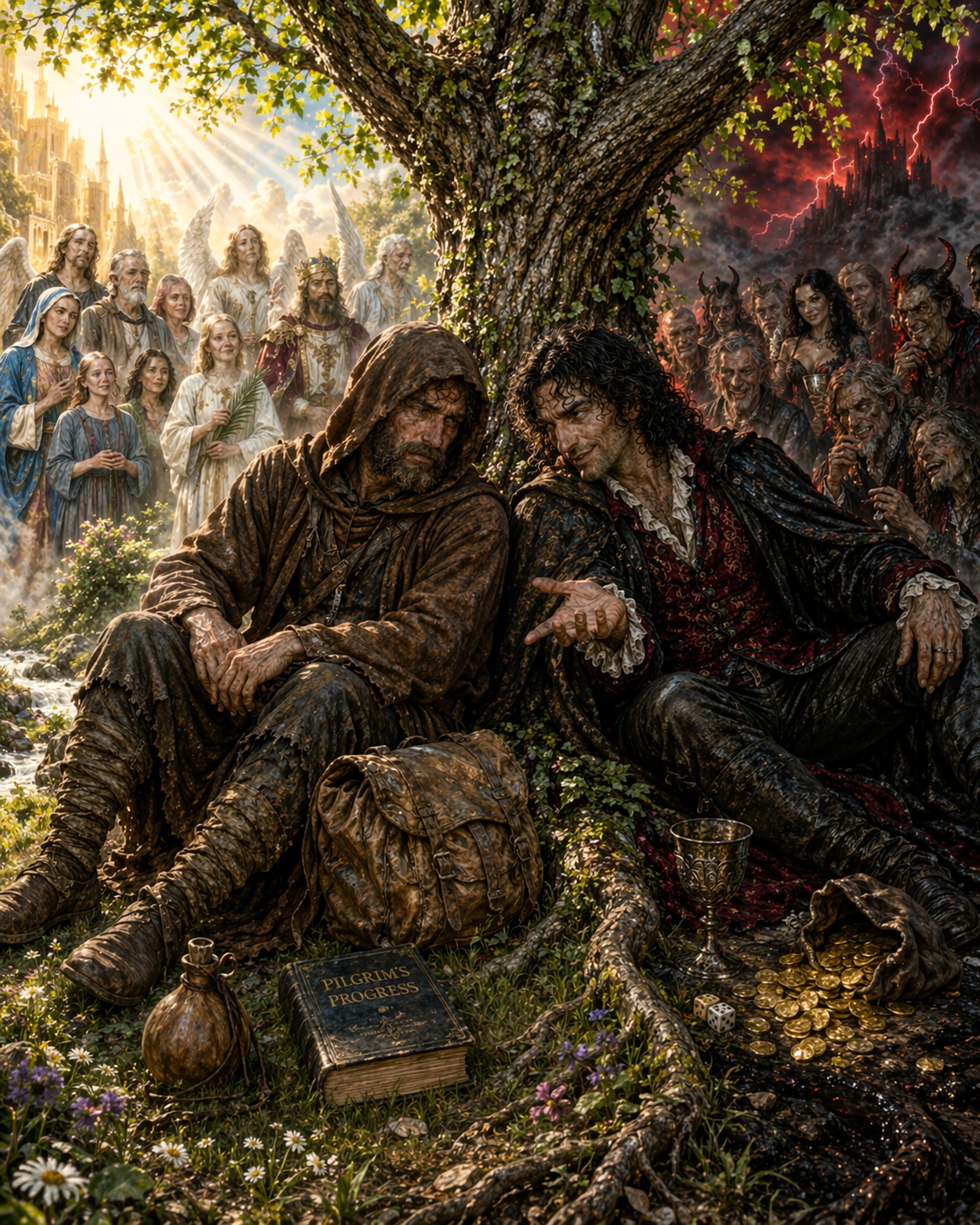
For three days I had walked through a vast emptiness of land since the last city I stepped foot in. When I walked I noticed my satchel matched the scenery I now walk in, no coin, no bread, no comfort worth naming, just emptiness, yet for all my lack, I still lived, and that itself was mercy.
In time I became somewhat accustomed to hunger and thirst, the body would complain, as bodies do. b I had learned that when I turned from its cries and lifted my heart toward God, He often met me with a quiet deeper than relief. It was not that the pangs of want vanished, but that His peace settled over it, and for a little while the soul stood taller than the flesh.
So I kept the pace slow. I had no place demanding my arrival, no real need of urgency pressing at my back. I wandered as one free to notice what others hurry past. At times I would stop along the path and bend low to smell the flowers growing wild by the roadside , and in such things I found the quiet evidence of God’s hand. Then, having taken in those small mercies, I would go on again at the same untroubled pace, I would arrive in whatever state and time already laid out before me.
Today, however the day was warmer than most, and though I had borne the heat without complaint, I felt a small growth of relief when not far ahead, I saw a great tree casting a wide pool of shade upon the ground. I smiled to myself, how lucky it seemed that such a small luxury should be waiting for me in the middle of never ending empty road.
Yet as I drew nearer, I saw that the shade was not mine alone because a man sat beneath the tree. He was not rugged in the way of field hands or artisans, nor soft in the way of merchants untested by the world’s wild. I could tell at least from here he was clearly a traveler, though how far he had gone or how often he wandered, I could not say. Still, there was something about him that told me he was no stranger to an open road.
The closer I came, the more clear his features became. His skin had been was a deep bronze , such as was when touched long by the sun, and in that at least my first thought proved true. He seasoned for the most part, yet something about him sat oddly with me, though I could not then have said why. He did not look weary. His clothes, though plain and not extravagant, were not ragged, nor did they carry the dust and grime one would expect from a long journey beneath such a sky.
When I had come within twenty paces, he lifted his hand in greeting.
“How are you, traveler?” he called, his voice soothing and warm. “Fear not, I am no bandit or thief, only a man seeking a little shade from this wretched awful sun.”
He smiled as he said it, and there was a friendliness in him that could put a man quickly at ease.
I bowed my head in return.
“Greetings to you as well. May God keep you cool this day, and if there is room, grant that I might share the shade with you.”
The man answered me less with words than with a faint scoff caught in the breath of his nose. I noticed it, though I gave it little weight. Heat tends to sharpen the ears and makes a man attend too closely to things he would otherwise let pass. I gave no great meaning to it and came to rest not far from him beneath the tree.
For a moment he said nothing. He only looked me over with a slow and measuring glance before smiling.
“You look like a hungry man,” he said.
As he spoke, he reached into a smooth brown satchel and drew from it a loaf of bread wrapped in clean linen, along with a small handful of apples. At the sight of them, I felt my hunger rise more violently and loudly than it had all morning. He tore the loaf and handed half to me without hesitation.
Hunger got the better of me, and seeing no reason to refuse what appeared a kindness from a stranger, I received it with thanks. Then he placed a couple of apples into my hand and plopped himself beside me as though we were old friends meeting again after a great deal of time apart.
Before I ate, I bowed my head and gave quiet thanks to the Lord, not only for His mercy, for the shade, but for the hospitality of the man beside me.
The man turned his head slightly as I finished my prayer.
“So,” he said, “you give thanks for all the food you receive, even if it amounts to no more than a beggar’s handful?”
I let out a small laugh. “I would wager a man like me may indeed be little more than a beggar, for I have nothing beyond what I wear and whatever the Lord sees fit to provide.”
At this, a smile touched his face, though it was not a warm one. There was something else hiding within it, something I could neither name nor dismiss. It was the sort of smile that seemed pleased, but not comforted.
“Ah,” he said softly, “I have always preferred a man who can give thanks for little things. Faith is a beautiful thing, when done correctly and trust me when I say, you seem to be a man who knows what true faith is.”
I bit into the apple and gave a quiet chuckle, not to give any offense to him, but a subtle reminder of how eyes could be wrong… “Appearances deceive. I know only what God permits me to know, and I practice only what He has allowed me to practice. As for what is good and what is bad, I could not say too confidently. What I take for righteousness may still hide rebellion in places I have not searched or to ignorant to seek. Only God knows.”
I smiled as I said it, and for a moment the man said nothing. He only watched me as though I had offered him something more satisfying than just words.
After a little while I spoke again, hoping to know the stranger better.
“Tell me, friend, do you also believe? I do not often see men willing to share what little they have left unless the loving hand of the Lord has touched them.”
He gave a small chuckle. “Oh, at one point I did… very long ago,” he said, his gaze drifting into the distance. “It seems an age ago now. But no, not now. I know of Him, certainly, yet as for warmth in my heart toward Him, I would rather not say.”
Then he turned back to me and gave a faint shrug, as if speaking of some old acquaintance he no longer cared to visit.
He studied me another moment before speaking again.
“Tell me, pilgrim, you have traveled far and wide, had little to your name since you began, kept little, and I don’t have the slightest doubt that you have been shown kindness by many. Yet you do not hate even one of them?”
I considered his words before answering.
“I can see how a man may come to hate,” I said. “And truth be told, I would be a liar if I claimed anger has never came to me, maybe not openly but internally. At times it has. But I have learned that I must run quickly to the Lord when it does, for I easily come wicked behavior when I stray from grace.”
At this he laughed loudly, though I did not know what in my answer had pleased him so much. Still, I paid it little mind and continued.
“As for kindness, yes, there is some, here and there, though perhaps less than one would hope. But hope will survive even the harshest climate, if only a man keeps its flame alive.”
He bit into his apple and chewed thoughtfully, then gave a slow shake of the head.
“A good answer,” he said quietly.
“What of you?” I asked. “What brings you to rest under this beautiful tree? Are you a merchant, or a traveler bound to some work?”
He shook his head.
“I travel, yes, but my business is with the manner of men.” Then, with a smile and a slight bow of his head, he said confidently, “An actor, if you like. I entertain men with words, songs, and stories.”
The warmth of his smile was strangely genuine almost intoxicating in its ease. I nodded.
“You are the first of your kind I have been privileged to meet,” I said.
He laughed again, softer this time.
“Oh, I carry the title,” he replied, “but if you think on it long enough, you may find that all men are actors to some degree. I think I know the stage which you perform in rather well,” he said, winking at me before taking another bite of his apple.
“You are a man bound by faith. You do not fear the world so much as you distrust what it may stir within you, and so you walk. Not as a scared man runs, but as a disciplined one. You show kindness, though not in tangible things…yours is the kindness that comes in words, yes that’s it, words with enough sincerity and warmth to break down even the hardest of men. The stars and moon serve as your lamp by night, the sun your guide by day, and walk, walk, walk you do.”
He nodded slowly, admiring his own thought.
“I like it,” he said. “Simple. Very simple.”
I did not answer him at once, though within me I felt compelled to speak rather than remain silent.
“To some degree,” I said, “you may speak truth, though you give me way more credit than I deserve. Words are just that, words. It is the Lord who gives them warmth or leaves them empty. As for the comforts of this world, I am too easily distracted by them to trust myself near them for long.”
He shook his head and let out a quiet laugh.
“Humble, even while being praised. They were right about you.”
His words struck me, I turned to him with some confusion.
“who has known me well enough to speak of me so confidently?”
He looked at me with a small twist in his face, as though the question amused him.
“You have become somewhat known in the adjacent lands,” he said, waving his hand as though it were no great matter. “You have traveled far and wide, and tales from pass from place to place of a great pilgrim who walks the roads and leaves changed lives behind him. I could only make a good guess and imagine you must be that man. If I am wrong, my little search would have ended in disappointment. But, no, today I set out upon this road hoping to meet such a man, and now, at last, I find him sitting right beside me. The long awaited great and humble pilgrim”.
I shook my head.
“The problem with man,” I said, “is that when he is surrounded long enough by evil, he grows accustomed to it, in a weird way endures it. Then, if someone comes from afar who is only slightly less wicked and shows him a little warmth, he is tempted to exalt that man as though he were an angel or a saint. Far be it from me to believe I could rightly bear such a title or praise from anyone.”
I lowered my eyes a moment before continuing.
“What men do not see is myself when I sit in silence, or allow my thoughts to wander too long among old memories. I find within myself a wickedness they cannot account for, though God surely does. So let men praise me if they wish, I will deny them every time. Whatever good may be found in me belongs to the Lord working within me. Whatever evil or sin remains belongs to what I am apart from Him.”
At this, the stranger laughed, it was deeply and from the belly, with a force that surprised me. I did not take him for a lunatic, no, what I thought perhaps was a man who carried some old wound too deep and hidden for it to come out in words, so it escaped instead through odd sudden moments laughter.
“My goodness,” he said at last, his tone almost jolly, “you are even greater than I had expected.”
As he spoke, he reached into his things and drew out a small skin of wine, taking a long drink from it. Then he held it out toward me.
“Here. Have some.”
I shook my head. “No, thank you, friend. Wine has a way of dulling a man’s senses.”
The stranger gave an easy shrug and drew it back. “More for me, then.”
We sat together in silence for a little while. Then, stooping down, he picked up a small stone and tossed it with careless aim into a nearby ant hill, scattering the little creatures into sudden confusion.
“Tell me,” he said, watching them stir, “why is it that men are so quick to show the worst of themselves? Do you believe all men are truly evil?”
I shook my head.
“No,” I said, “not evil in the way men commonly imagine, as if only evil could be described in the way of murderers, thieves, or tyrants. But I do believe there is a great evil within us, one that is quite enough and rarely wanting to be exposed that makes us think ourselves better than most. that evil, I think, may be more dangerous than the violence of a man who kills half the world.”
“You speak so wisely,” he said, nodding as he stared into the distance. “ yet you cannot tell me you are not different from them. Not even in some small way? Does no part of you think this long road has brought you nearer to God than other men, made you better in some small insignificant way?”
I shook my head.
“No,” I said, then laughed softly only for a moment. “My walk may indeed have brought me closer to God, but above them? No. Apart or distinguished from them? No.”
I bent and picked up a small stone, turning it in my fingers before speaking again.
“say one blacksmith makes a hundred hammers in a day, or a lonely pilgrim takes a thousand steps upon the road, both are seen and known by God. Some may feel His warmth and cling close to it. Others may feel it only briefly before returning to the cold. Some do not yet even know a fire has been lit for them at all. But how the Lord meets each man, and how each man answers Him, is not mine to rule.”
I smiled faintly and cast the stone out before me.
“I have myself to deal with, and that alone is already more than enough.”
Having rested longer than was my custom, I at last stirred and rose to my feet.
The stranger beside me looked up with a flash of confusion and worry, “Where are you going?” he asked, and there was something oddly quick in the question.
I smiled as I reached for my satchel. “A road is only traveled if the feet upon it continue to move and I have given myself enough rest.”
At once the stranger rose to his feet.
“don’t leave me yet, perhaps I may still walk with you,” he said. “I have much to learn, and I would be grateful to accompany you at least to the next town.”
I paused to consider it. What harm could there be in a man walking beside me? More often than not it was only the Lord and I upon the road. Perhaps, I thought, this too was a small kindness granted for the day.
“Very well,” I said with a nod.
The man let out a breath, then lifted a hand.
“Only, would you mind waiting maybe twenty minutes more? I have not finished eating, and I would rather not walk with fruit in hand. The dust from our steps will stir the dirt and grime into the air and it would cling to it. Surely that would spoil the sweetness. Why should I ruin a good thing by rushing to the next place?”
His words settled in my mind. It was not my normal for me to remain long in comfort, but perhaps there seemed a small logic and reasoning behind what he said. Maybe, I thought, the stranger had a point.
So I began to set my satchel down again.
At once he clapped his hands together, smiling wide with a warmth that nearly spilled over.
“Good!” he said. “I was not yet done talking anyway.”
Thinking little of it, I lowered myself once more into the shade beside him.
The man took another bite before glancing at me.
“Are you always so eager to hurry toward the next place?” he asked.
I shook my head.
“Hm?” he pressed, as though he had not expected the answer. “It seems so. I have often wondered, when a pilgrim grows tired, does he simply lay himself down wherever he finds ground enough for it?”
His question lingered with me before I answered.
“I walk by day,” I said, “and a small rest is no evil thing. But long drawn out rest has a way of breeding idle feet, and idle feet soon give way to idle hands. Idle hands make room for idle thoughts, and there the enemy is rarely is slow to enter.”
The man let out a small chuckle.
“Are you always so philosophical in your answers?”
Again I shook my head. “No.”
He smiled faintly and leaned back against the tree.
“Then why can a man not simply rest? Why not sleep a little in the day, if the body asks it of him? you do not think God would hate you for such a thing.”
His words struck me as somewhat odd, though not false in the plainest sense.
“Hate? No,” I said. “God hates no man. Rest, by itself, is not wicked. Our Lord Himself withdrew and rested many times. But rest becomes dangerous when the intent beneath it is twisted.”
He watched me closely as I continued.
“If I surrender myself at the first sign of tiredness, I begin answering too quickly to the body’s demands. I listen too closely to it. I bargain too freely with it. When that becomes a habit, the soul finds less and less room to grow strong.”
At this he slowly shook his head.
“I do not think that can be so.”
“Do you think,” he asked after a small pause, “that perhaps you despise rest because you wish to remain in a state of strain? That maybe you have grown so used to burden that peace itself now feels alien to you?”
I let out a small laugh.
“This is a battle I have fought many times,” I said. “But no, I do not think that is the case now. I know enough of my own wickedness to know that a little can go a very long way. As the Lord said, a little leaven leavens the whole loaf.”
At this he scoffed.
“Christ speaks too modestly at times,” he said. “It is as though He gives a vague answer broad enough to fit whatever men wish to throw at it to make Himself appear more logical.”
I turned and looked at him then, and perhaps a measure of suspicion passed over my face, since he was quick to step back from his own words.
“Forgive me, pilgrim,” he said. “I let my own harshness toward Him cloud what you clearly hold in reverence. What I meant was only that perhaps He may be misunderstood at times.”
I gave him no answer. There are some words that do not deserve one.
Then, as though eager to move beyond what had just passed between us, he rose to his feet and brushed the dust from his clothes.
“None the less,” he said, “shall we begin our walk?”
I nodded and rose to my feet, but deep within some part of me, like the ringing of the sous bell urged me to turn and go the other way, or else say farewell then and there. Yet I dismissed it, telling myself it was likely nothing more than a kind of banter to which I was not used to anymore. A lonely traveler may begin to find many things strange after too long in his own company.
So we set out together.
As we walked, the man reached into his bag and drew out yet another apple.
Strange, I thought. The dust no longer troubles him.
But I kept the thought to myself.
“Tell me, pilgrim,” he said after a while, “I have a problem, and I would hear your judgment of it.”
I glanced toward him but kept my pace.
“I once loved God, some long while ago,” he said. “But my heart is now divided against Him. Tell me, why does He not allow peace? Men die. Women die. The old die. By far the most heartbreaking, the little ones, hardly having learned to walk, are taken away by death. Why? I feel anger or harsh towards Him for this.”
His words lingered heavily in me and I thought, a man can feel such things rise within him. However what man truly knows the counsels of God?
I drew a slow breath, whether from weariness, the weight of food in my belly, or the burden of the question itself, I couldn’t say.
At last I answered quietly.
“You mistake God,” I said, “and you mistake man as well. God does not delight in evil or in death. If He did, you nor I would be standing here drawing breath freely. What God permits, and what He accomplishes through what He permits, often remains a mystery. Not all things are known to men, and perhaps some were never meant to be for our wellbeing.”
I looked ahead as I spoke.
“Evil continues because man is fallen. We are tainted. Even the newborn child, though innocent of conscious wrongdoing, still bears within the human condition, the seed of corruption and the capacity for rebellion, as all of Adam’s children do. Thus evil has room to stretch its fingers upon man, and evil being what it is extends its hatred even toward what is tender and precious.”
The man shook his head.
“Can a man not be angry at God, even a little?”
“Certainly he can,” I said. “whether such anger is justified is another matter.”
I was quiet for a moment, then went on.
“If I were given a child, would that child truly be mine before belonging to God? If all things come from His hand, what argument could I bring before the Creator that would make my complaint righteous? If in His will one thing is permitted to live and another is permitted to die, my place is not to place Him on trial, and I in my own arrogance become the judge, no, I must only give thanks in both sorrow and joy.”
“Always a fitting answer,” he said with a smile. “Tell me then, if God stripped you of your belongings here in this road tonight, and left you bare and exposed beneath the sky, could you still praise Him as the sun burned your skin tomorrow? Could you still give thanks and tell Him you loved Him, even while He knew your need and yet seemed to move against you?”
I gave a small laugh and looked toward him.
“You speak like a man who knows much of being stripped of what he once held,” I said. Though his face fell flat, he said nothing.
Then I looked back to the road.
“Even so, let God take what has always belonged to Him, if such is His will. I shall praise Him still. My words may come out dry for lack of water, yet my heart will still pour forth a river of living water even between weary breaths.”
At this, the man flung the remains of his apple aside, and I sensed in him the first small stirrings of irritation.
“Fine,” he said. “If such thoughts help a man sleep better. But God cannot simply go about giving and taking as He pleases.”
I shook my head.
“Oh, but you’re wrong, He who brings forth life and sustains it at every moment surely may do as He wills with what is already His.”
The man scoffed again, though this time he said nothing in return.
After a few moments he slowed his pace and touched at his heel.
“Come,” he said, “let us take moment by that boulder. I believe a blister is forming.”
I had no wish to pause again, neither did I desire to press a hurting man further into pain. So we stepped aside and came to rest near a small boulder by the road.
We sat there together, both gathered into the narrow shade the great boulder casted on the ground. Silence kept us a while, but before long the man did something I found deeply strange.
A small insect passed near us, making its way harmlessly away. It had done nothing to trouble either of us, yet he reached down, plucked it up between his fingers, and with a quiet sort of focus began removing its legs one by one until none remained.
A sourness rose within me at the sight.
“Tell me, pilgrim,” he said at last, tossing the broken thing aside, “if God loves peace, why did He allow me to do harm?”
I did not answer him at once. Instead I paused and prayed inwardly for patience, both for him and for myself.
“Ah,” he said, “praying for me?”
He smiled faintly.
“Thank you, but God will not listen. I have a strong suspicion He does not care much for me.”
I shook my head.
“Whether you truly believe that or not, I shall pray for you and for myself as well.”
A moment passed. He slipped off one shoe, rubbing at his heel, while I gathered my thoughts.
“Evil is evil,” I said at last. “God may permit it for a time, but that does not mean He blesses it, nor that He will suffer it forever. You will answer not only for the act itself, but for the movement of heart that gave birth to it.”
I lowered my eyes briefly, then continued.
“Evil often believes it can stain what is good beyond repair. At times it can make a cut deep, yes. But not always, and not forever. A day will come when it reaches its end.”
He laughed quietly.
“Surely. But until then, evil remains.” He said almost confidently, assured his answer was true.
Then he lifted his wine skin and took a long drink before holding it toward me.
“Here. Take some. The road is yet long.”
I declined him gently.
“No, thank you. Even in thirst, let me not cloud my judgement.”
Again he laughed.
“I do not mean to press you so heavily, pilgrim,” he said, his tone softening. “There is pain in me, and I believe you may be the only one who can help me bear it.”
I answered softly.
“No. God can. I am only a simple foolish man.”
And so we sat there, for what felt like hours. Time slipped past me in the silence that settled between us, the battle of my inward thoughts.
To quickly, the sun began to sink, in a sudden panic I lifted my eyes and took proper notice of the light. Dusk was no longer not far from us.
A sigh escaped me.
“We have missed our time to walk by day.”
The man looked toward the lowering sun and then back to me.
“Forgive me, friend,” he said. “I had not realized how pleasant this quietness could be. It seems I have pulled you away from your purpose for the day.”
I dismissed it with what kindness I could manage.
“Then let us rest,” I said.
So I knelt down and began, however wearily, my normal order of prayer for the evening.
“Pilgrim,” he said, just as I had started, “before you finish, let us speak a little more.”
The interruption caused my thoughts to drift enough to cause my loss of focus, forcing me to begin again.
“Surely,” he said, “prayer can wait a moment.”
I gave him no answer. I only continued.
“Very well,” he muttered at last. “Then a fire is what we need.”
Whether I had become so fixed on my prayers that I lost track of time, or whether he truly worked with unusual speed, I could not and dare not say. But before long I heard the crackle of a small flame and felt its warmth begin to rise against the evening air.
When at last I finished and lifted my head, I found a fire burning before us.
I looked first at the flames, then at him, puzzled.
He laughed softly and tossed a small twig into the fire.
“I am quick to make myself comfortable,” he said. “A man learns such little tricks when he has enough idle time to gather them.”
I watched the twig curl and darken in the heat, and a thought passed through me that his words had carried more than their plain meaning. It seemed to me, in that moment, that he spoke not only of wood , as though this twig had a deeper meaning, his only confirmation a small smile and nod.
So he shifted and settled himself more deeply by the fire.
“Another question,” he said. “What do you make of evil?”
I kept my eyes on the flames.
“Evil is that which is apart from the Lord in want and desire,” I said.
He scoffed at once.
“Oh, come now,” he said, almost pleading. “Give me a real answer. I do not want a polished one, nor a “look-how-holy-I-am answer”. I want yours. A true one.”
At brazenness and lack of common decency, I felt something rise within me. My chest tightened. My breathing picked up. A heat began to stir within my belly that had little to do with the fire.
“There,” he said suddenly, pointing at me. “Yes, that! Let me hear that part of you. The true you.”
At once I lifted my eyes toward the heavens.
“Lord, help me, a sinner,” I said softly.
“do not be like that,” he replied, tossing another twig into the flames. “Words are not sinful merely because they are sharp. A little anger, a little frustration, does it not simply prove you are human? You yourself said He made you, did you not? Then He made anger as well. Why fear it so much? It is natural.”
Again I prayed inwardly.
Lord, help me, a sinner.
“And besides,” he continued, “does not God hate evil? If he allows you to feel it then surely you are safe enough. Let me hear a little heat from you, pilgrim. There must be some part of you that wishes to let me see it.”
“Tell me, stranger,” I said interrupting his taunts, turning my eyes from the fire to his face. “You called yourself an actor. Let us suppose an actor takes the stage and performs poorly, missing every line, spoiling the scene, and bringing confusion upon the whole production. Should we still call him good, even though he failed to perform rightly when the moment came?”
The stranger grew very still.
“Ha,” he scoffed. “Even a poor actor is still above the fool who pays to sit and watch the show.”
I shook my head.
“That is not what I asked.” I said pressing him.
He brushed a little dirt from one small pile into another, as though my question had unsettled him more than he wished to show.
“No,” he said at last, exhaling through his nose. “No, it is not.”
Then a small chuckle escaped him.
“I had heard you were good, pilgrim. I may have underestimated you.”
He tilted his head and gave a faint shrug.
“Very well, then. No, the actor would be poor, and he should be called poor.”
I nodded.
“And if the writer of the play entrusted the man with his lines, expecting that when the moment came he would perform them faithfully, then a good performance tells the writer something. It tells him the man cared enough not only to remember what great responsibility was given to him , but to act it in such a way that it appeared he truly believed the part he had been entrusted to carry.”
At this, the stranger laughed again.
“True enough,” he said. “Then tell me, are you not also an actor?”
He leaned toward me slightly, the firelight dancing across his face.
“You wish to do one thing, yet perform another because you fear the writer’s anger or disappointment. Better to perform well for now, I suppose. At least there is an audience before you to give Him a worthy show.”
“I suppose,” I said, “if we must still speak in terms of plays, then perhaps I could be called such a thing. But my audience is not man. It is the Lord, and all the heavenly host who watch beside Him.”
I looked into the fire as I went on.
“The people seated in the crowd will never notice when the actor stumbles. They may miss every flaw. But the writer who made the character, who shaped the scenes and entrusted the lines, knows every failure perfectly. Nothing escapes him.”
Then I turned my eyes back to the stranger.
“So yes, if we must keep the image, then perhaps I am on a stage of sorts. Yet I care nothing for applause. My desire is not to impress the crowd, but to show the Writer that I would deny what I am, who I am by nature in order to become what He requires of me in whatever scene He has set before me.”
At this, he laughed harder than before.
“Very well, pilgrim,” he said. “Have your audience.”
I did not laugh with him.
“But know this, stranger, I am no performer. I am only a man who knows that left to myself I would ruin every scene placed before me. If anything good is found in me, it is because God Himself creates within me the man I need to be.”
“Then your writer is unfair,” he said. “Should he cast you into roles only for his own amusement? Even now I can see how anger burns in you, yet you force it down with such effort discomfort is painted across your face. God may sit high above applauding Himself, while you sit here wrestling both your own heart and His demands. It does not seem a very good trade, if you ask me.”
I shook my head.
“Surely you do not mean that,” I said. “A man in pain is often to quick to mistake his wounded heart for wisdom, and his anger for truth. But bitterness has never made a thing better or more whole. It only teaches the eye to hate the light that exposes it.”
“How old are you, pilgrim?” he asked. “Middle-aged, perhaps? what could you possibly know of God enough to speak of Him so confidently? You say evil has its limit and its hour, but has not evil known your God longer than you have? Might it not speak more truly of His bitterness, of a God who denies what He Himself has made, only to preserve His own pride?”
At those words, something in me shifted.
It was as though an unseen current leapt from the shadows through the space between us. The air itself seemed charged, and beneath the smell of fire and dust there came upon it something else, something like the scent of a grave newly opened.
I gave him no answer.
My silence seemed only to trouble him further.
“Every so often,” he said, his voice sharpening, “someone like you comes along, speaking of humility, of peace, of calm restraint. even now, I commend you for holding yourself together so well.”
He leaned in slightly, and his eyes fixed on me with a strange intensity almost a disgust.
“But God sees you, pilgrim. Play your little game of hide-and-seek with devotion and prayer all you wish. I see you better than you know yourself.”
“No,” I said, holding his gaze. “You only see what you wish were true.”
At this, the man rubbed his forehead and let out a low, irritated grumble.
“I find you unbearable, pilgrim. Do you think these long walks on empty roads save you? Do you imagine they keep evil from you?”
He leaned forward, his voice tightening.
“Let me press you further, then, O wise and humble one, do you think evil has forgotten what you once were? What you have done? Walk on if you like. Keep your calm demeanor before men if it pleases you. But do not pretend you are anything other than what the rest of them are, just a wicked little man.”
His eyes narrowed.
“And perhaps when you finally accept that, when the realization finally destroys your false reality, you will cease placing such foolish hope in a God who seems only to test you.”
I laughed, and at once a snarl broke across the stranger’s face.
“Oh,” I said, “I am more wicked than evil itself could ever fully imagine. For all the power evil claims it possesses, it still fails to grasp even this simplest thing any human could understand simply.”
The man let out a dark grumble.
“Choose your words carefully, pilgrim. Evil has a way of proving men wrong.”
I shook my head.
“And that is precisely the problem with evil,” I said. “Even when it tries, it still cannot.”
The sourness in his face deepened.
“Explain,” he snapped.
So I did.
“Evil may come from within me, for I am indeed wicked. It may come through the adversary and through those spirits who serve him…”
He cut me off sharply. “I would not call them servants as though they lacked power.”
“Very well,” I said, lifting a hand. “However you would name them, they may influence, tempt, and press a man. But the evil is still mine when I consent to it. even if the enemy knows much about me, he cannot see into me as God can. He may guess and guess really good at my weakness. He may study my habits. He may know where I bend most easily. But he cannot behold the full depth and complexity of my corruption. God alone sees that clearly.”
I held his gaze.
“here again evil fails…God allows me to see enough of my own wickedness not to destroy me, but to teach me how desperately I need Him. The more truthfully I learn what I am, the more clearly I see that I can never fight my evil except by clinging to the One who is good.”
The man spat.
“You think you know anything?” he snarled. “You think you can speak of evil with your thin words of piety and somehow know us?”
And in that moment, clarity struck me.
The man had indeed been an actor, the best I have ever known. He had worn the shape of a man, spoken with the tongue of one, and carried himself with the ease of a traveler, but all of this a great role for he was the enemy all along.
I nodded. My heartbeat raced heavier and quicker.
“You, as you said,” I answered calmly, praying inwardly that the Lord would keep me in that hour of suffering, “understand evil. And how could I, a man born yesterday compared to those who long ago betrayed their duty, claim to know it as you do? In that, you would be correct.”
I held his gaze.
“But even now, after ages have passed, you still lose. Your hands may move others by influence toward evil, but you yourself know nothing of the power of mercy. You believe evil is the answer, that it is too deep to be understood, too powerful to be ruled, too ancient to be overcome. again, in part, you speak truth. That is precisely why I surrender my wickedness to the Cross, for only He can wash me clean.”
At once the man flung dirt toward me.
I rose, and he rose with me, standing within inches of my face.
“You truly are a wonderful and faithful servant,” he hissed. “So full of humility. Tell me, how is one as cunning as we, meant to defeat such a man?”
Though fear moved through me, I held my ground, and my voice rose stronger than I felt.
“It was never I,” I said. “God alone has defeated you.”
At this, the stranger let out a shriek so terrible that the very air seemed to split beneath it. A violent wind burst forth, and I threw up my arm to shield my face. When finally the gust passed, the stranger no longer stood before me.
The fire had gone out.
At once I fell to my knees. Trembling, I lifted my hands toward heaven and cried aloud, “Save me, O Lord!”
Then my head dropped, not in defeat, but in holy fear at what I had unknowingly walked beside. As I knelt there in the deepening dark, a small flame stirred again within the pit. It caught, and rose, and once more the darkness found no room around me to call its own.
I remained there for some time, unable to tell whether the trembling in me came from fear, from relief, or from the terrible knowledge that evil had not come to me with fangs bared, but with bread in its hand and kindness on its lips. I did not seek to devour me by force, but to delay me, study me, flatter me, soften me, and, when those failed, provoke from me some hidden anger I was more than capable to use that it might call my truest self.
Then I understood more clearly than before that the enemy rarely wastes his strength appearing as a great evil wicked monster, when a gentler mask will do. He will come as a friend when hatred would alarm you, as reason when madness would cause second guessing, as comfort when open temptation would be resisted. He will speak enough truth to gain your atrention, enough warmth to lower your guard, and enough patience to walk beside you until you mistake his presence for companionship.
I exhaled and noted to myself that not every voice that speaks softly is sent in peace, and not every hand stretched out in seeming kindness comes from God. The enemy is ancient, and he has studied the weary depths of man well. He knows when to accuse, when to flatter, when to comfort falsely, and when to whisper that delay is harmless. He changes his form because he has no truth of his own to stand in. He must borrow, mimic, distort, and disguise.
Blessed, then I said aloud, is the man who does not trust every spirit, nor every inward stirring, nor every sweetness that asks him to step from his watch. For many are not ripped from the road by open rebellion, but by small permissions, subtle counsel, and the slow ruin of holy caution.
That night, when I finally rose again, I did so with slower steps and sharper eyes. I thanked the Lord not only for preserving me from what had walked beside me, but for showing me that evil is often most dangerous when it appears almost human.
So I took up my satchel, turned again toward the road, and walked on beneath the first stars with prayer upon my lips, asking God to keep me watchful until the day when all disguises are stripped away and every false tongue is silenced before His everlasting fire.